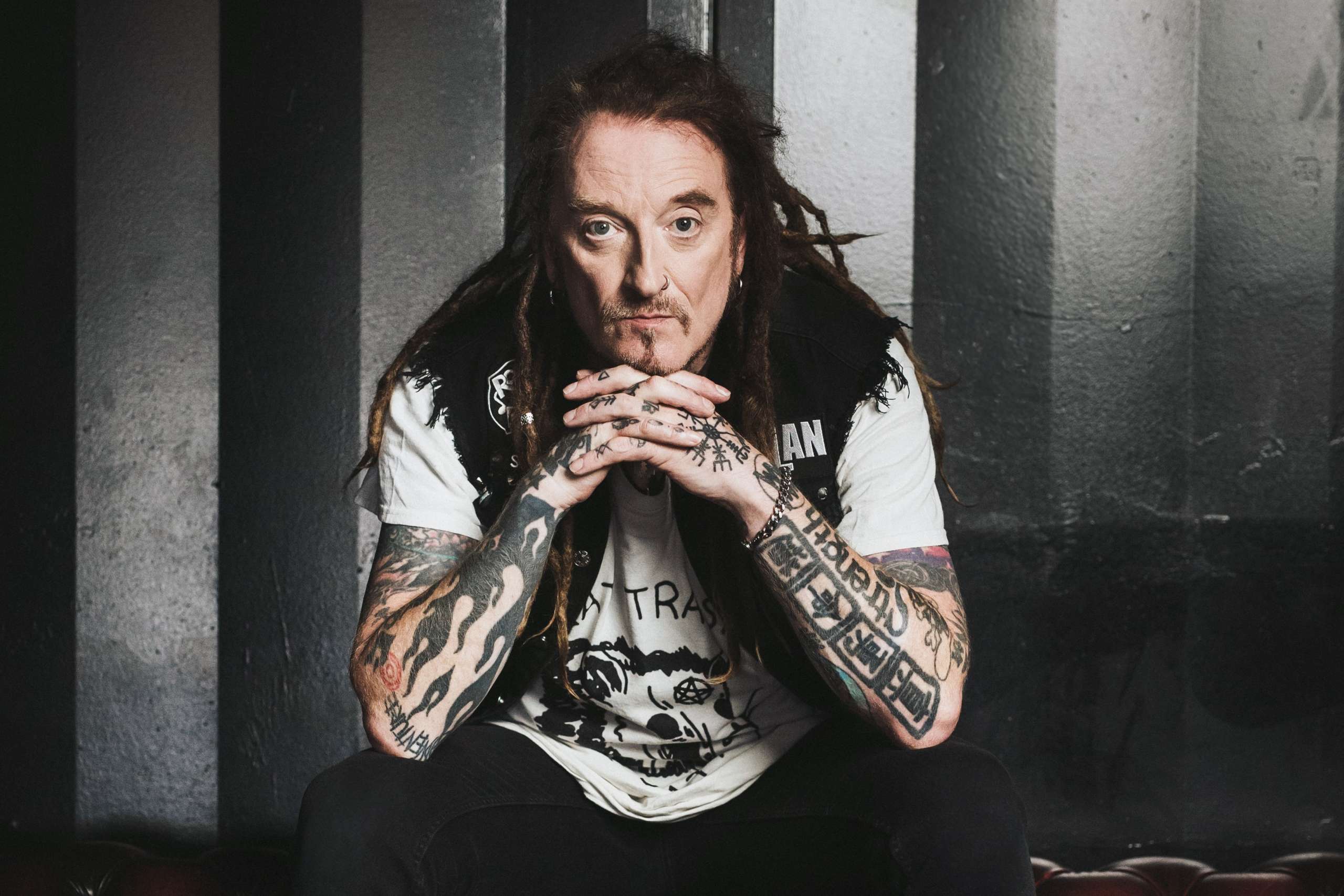

Photo Credit: Andy Ford
We catch up with Ginger Wildheart backstage at Download Festival, the spiritual home of British hard rock and heavy metal, where The Wildhearts have once again found themselves returning to the place where so much of their history has unfolded. By his feet his best friend, the adorable border collie Maggie, is running out excitedly having just been the best stage invader of the weekend during the Wildhearts‘ set, with the mainman joking that she is “more famous than the fuckin’ band.”
Ginger is in a great mood, greeting old friends, and making new ones too. Speaking to him, he oozes charisma but he also seems massively happy, comfortably at peace. On the back of the headlines of his cancer diagnosis, and the tragic news that one of British rock’s most gifted and chaotic songwriters is now talking openly about what comes next, he is happy.
Around us, the usual festival madness churns away. PR’s are chasing band members and shepherding them towards writers and journalists at one end, while at the other drinks are being shared. And Ginger, one of the greatest musicians in British rock, seems entirely at ease with it all.
For more than 30-years, The Wildhearts have existed as one of those rare bands that never really belonged anywhere except to the people who needed them most.
I’m still baffled as to how a band with their back catalogue of songs, their melodies, riffs and encyclopedia of hits aren’t bigger in the mainstream than they are. But for three-decades they have endured, they have thrived, equal parts, rock, melody, punk, metal, chaos and adoration.
Most of all though they matter and The Wildhearts have always been a band that people built their lives around, they have a long established fan base, a community. Which may explain why asking Ginger to rank his own songs proves almost impossible. After writing more than 600 original songs across The Wildhearts, solo records and countless side projects, surely there must be four songs that stand above the rest? A Mount Rushmore of songs he has penned?
Not according to him.
“I don’t think I could narrow it down to four songs, that would be almost impossible,” he insists. “I’d say Time, from the 555% sessions would be number one, but I’d be trying for weeks to think of another three. I write in so many different moods, and from different perspectives. It would be easier to pick my four favourite pissed off songs, or my favourite four about my dog.”
It’s a wonderfully Ginger answer with the frontman being as comic, evasive and self-deprecating as ever. But buried within it is the truth of why his catalogue has always connected so deeply. Most songwriters spend a career refining a single voice, while Ginger writes different songs depending on his mood. A song he writes while furious is entirely different to one when he is hurting or in love.
And perhaps that’s why generations of outsiders found themselves reflected in it, and The Wildhearts have always been a band for people who didn’t quite fit.
We ask Ginger why his music reached those people when so many bands never do, and he doesn’t talk about songwriting techniques or marketing strategies. He focuses on different factors.
“I grew up on music for outsiders. I used to go to Ramones gigs without a ticket, and see a venue full of weirdos and freaks. I’d always get in and I’d always get somewhere to stay.
“I guess that type of community set me up for The Wildhearts. It was a similar vibe with The Damned and Motorhead, where all types of people would congregate, but no-one brought the outsiders together like Ramones. I’m proud to have brought together a similar community. I understand their struggle.”
Maybe the secret is that Ginger wasn’t observing those outsiders from a distance because he is one of them, one of us.
The Wildhearts were a formative, life shaping band for me, your Bring The Noise UK writer. My first ever rock CD was their EP Don’t Be Happy Just Worry. They are a band I will carry with me forever, the same way previous generations carried AC/DC, The Beatles or Iron Maiden.
I tell him Ginger all these things I’ve wanted to say for years and ask him if he is aware of the mark he has left on people musically over the years.
He smiles: “Music has saved my life on too many occasions to mention. I fully understand how much it means to people because it means that much to me. I feel like we’re talking exactly the same language. This love connects us all as a community. And I have always valued that more than money or success. For some people music is a job, for me it is who I am. I think people can see the difference. The Wildhearts community have allowed me to do this because they can see my authenticity. Music is the power that unites us.”
For a moment, everything else falls away but these days, of course, conversations about Ginger inevitably drift toward bigger questions. Recently he’s spoken openly about his diagnosis and his decision not to pursue treatment. It’s the kind of subject that could easily dominate every interview, but when I ask whether it has changed his relationship with music, life or himself, his answer is unexpectedly calm.
“Not at all. I moved to the middle of nowhere to find peace and balance. It gave me an insight into the illusion of the physical world and how we evolve beyond this. We don’t die, we move on. I feel this as strongly as I feel anything, even music. So I was already connected to a higher source before the diagnosis. I’m ready for the next step.”
Then he adds: “I don’t believe in coincidence. I think this is the path that was meant to be mine, and I am very grateful.”
He genuinely seems to be at peace as we chat amidst the chaos of Download, which brings us back to this famous festival and Donington Park. Back to the festival that has intersected with The Wildhearts‘ story for more than three decades.
This year’s appearance feels different as the band were added late, after a special slot was created specifically for them, with an invitation carrying far more emotional weight than a routine festival booking.
“The fact that Download has created a slot especially for us makes this appearance all the more relevant. We are so honoured to be asked to play at such a late date, when all the other acts had been confirmed almost a year before. Every time we play a festival it’s always a lot of fun, but this one feels extra special.”
If there’s one thing immediately obvious when talking about the current Wildhearts line-up, it’s how much happier Ginger seems. The old Wildhearts story often revolved around conflict with infamous tensions, break-ups and chaos, but those days are firmly in the rear-view mirror.
“Playing festivals with this line-up is always great fun. We just rock up, kick ass and have a laugh. There is always a lot of laughter with this lot, the positivity is what fuels us. There was once a time where the drama and the tension was the fuel, but that gets exhausting to the point where you don’t even enjoy it anymore. Or at least I didn’t. I’ve worked too hard at this band to be unhappy doing it.”
It’s obvious The Wildhearts are being powered by joy today but of course, no conversation about Donington would be complete without memories. The Wildhearts first played here in 1994 and now in 2026, some 32 years have passed and the band are still standing, still kicking ass and still creating. So what remains his favourite Donington moment? Naturally, it’s the time everything went wrong or went right if you’re Ginger.
“Oh definitely the time they pulled the plug on us. It was a magical set where you could see the crowd get bigger and bigger. The organisers got nervous at how rambunctious it was getting, but when I was a kid that’s how crowds reacted when something special was taking place. It felt like I’d come full circle from being in a crazy crowd to making one.”
And there, perhaps, lies the perfect Ginger Wildheart story as he and Maggie wander off through the backstage area and disappear.