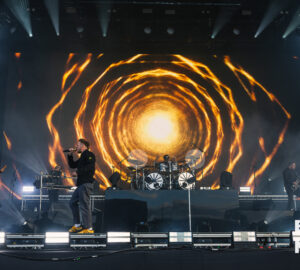

Photo Credit: Harry Steel
We catch up with Will Gould backstage at Glasgow’s OVO Hydro. He’s all smiles and obvious excited energy, as we stand and chat as road cases rattle past and the air is filled with the sound of distant kick drums bleeding through concrete walls.
It is cold, mid-December in Scotland and our breath hangs fogging slightly in the air as we discuss all things Sanguivore II: Mistress Of Death. Later tonight, Creeper will take to the stage for their set as support for Ice Nine Kills, and Gould is leaning against a table, his beanie hat pulled low in a bid to help fight off the biting chill. But he is buzzing and chatting with a grin to Bring The Noise UK, eyes bright, ahead of showtime.
There’s a sense, or with this band a cast iron coffin clad guarantee, that something theatrical, slightly dangerous and undeniably dunked in rock n’roll excess is about to happen. And that, really, is Creeper all over in this era.
“Yeah, yeah. It’s a silly, a pretty silly record,” Gould grins, when the subject of the band’s new album, Sanguivore II: Mistress Of Death, comes up. He says it proudly and confidently, and with the authority of a man reclaiming the old adage that taking things seriously doesn’t mean taking yourself seriously all the time.
Because if Sanguivore II is silly, it’s silly in the same way David Bowie was silly, or Alice Cooper, or The Damned. It’s grand, arch, melodramatic, deliberately and spectacularly theatrical. It’s rock music with a wink, a cape flourish and is full of glorious pomp and excess.
“Do you think that rock music, people are scared to be a bit silly or have a bit of fun with it now?” we ask.
Gould doesn’t hesitate. “I think the more boring aspects of rock music take itself too seriously,” he says. “I think, historically, in this country, we’ve always been very good at laughing at ourselves, you know? Yeah. And being self-aware. It seems to me that somewhere along the line with rock music, it became a little less self-aware and less keen on making fun of itself.”
Gould is a thoughtful, articulate and quite brilliant frontman. But also one that is keenly aware of rock history and unafraid to nod or doff his cap in the direction of his peers or musical heroes.
“And Creeper’s not that way, you know? The best of the genres make fun of themselves and lean into it. And Creeper’s a huge bit all the time.”
This sense of self-awareness is key to understanding Sanguivore II. It’s a sequel, which is something Creeper have never done before and really never intended to do, and in a genre that’s increasingly obsessed with legacy, Gould is very conscious of how easy it would be to slip into parody or repetition.
“Well, it was weird because it was the last one. We never anticipated doing a sequel, really, at first.” He laughs at the contradiction. “It was one of those where we’d never done one before. And so we already had the framework in mind.”
Traditionally, Creeper’s modus operandi has been to burn the world down, start again, new sound, new style, new image, new myths. “And we’re so used to destroying everything, tearing down a record, and then rebuilding and reshaping everything. So it was a strange thing to do.”
But this time, the world already existed and it was one the band feel not just comfortable but are thriving in. “But on this occasion, we already had the look and everything has to be a little bit revising.”
The look, all vampirish stage make up, as Gould tells it, didn’t begin in a rehearsal room or a writing session, but somewhere far more natural, organic, on the road in America.
“But the story came to us when we were in America dressed as vampires…” he trails off, trying to remember. “We were somewhere in America. I can’t remember where it was. And I was like, we are. We’ve become this vampire rock band, whether we like it or not.”
The irony, of course, is that Creeper didn’t invent this aesthetic fully formed. Their audience did.
“Because the makeup that we wear on stage now, we weren’t really wearing that for the first Sanguivore record. It was kids that started coming to the shows dressed as it. And we were like, we should probably be doing this as well.”
There’s something beautifully old-school about that, where fans helped to shape and create the new myth. Gould and the band were open enough to identify this, embrace this and fully lean into it.
Given the success of Sanguivore II, the obvious question looms. Could this be the middle episode in an epic undead trilogy?
“Because the reaction has been massive, hasn’t it? It’s been great. I think, honestly, this era of the band has been the most successful in so many ways.”
But Gould is wary. “Again, I think the cool thing about the sequel was that we managed to not make the same record twice and keep it in the same world. And there was a lot of artistic ground we broke with it, with different sounds, different instrumentation, something like Razor Wires, something we’d never written before. So in terms of making a trilogy, what I’ve been trying to say is, if it feels like there’s something artistically to gain from it, or something more we can do with the sound, and not just retrace our old steps, then perhaps. But it’s too early to say, I think.”
Part of the tension here lies in Creeper’s long-standing love of reinvention. Their continual evolution, which ensures they stand out from the pack and are so beloved by their fans. “You find something you’re really clicking with the fans. I also think that half the bit is all the time, it’s like, how can we catch people off guard?”
Gould smiles, remembering earlier incarnations. “So much of what we did when we were younger was about breaking the band up for a year and coming back. We had a completely different look, ignoring the black and moving to white. There’s a colour palette and changing everything. It came to a point where people were expecting us to change. So we thought the thing we could get away with the most was staying the same.”
And therein lies the genius twist of Sanguivore II. “The one thing they wouldn’t have expected was us to do a sequel.” Which makes the idea of a third chapter fraught, and reading between the lines probably unlikely. “That’s why anticipating a third one is so difficult, because if people are expecting us to do that, is that the right thing to be doing? You know what I mean?”
Visually and sonically, Creeper are now deeply entrenched in the gothic excess of the 1980s, an era which strikes a deeply personal chord with Gould. “Yeah, of course. So much of what the band looked like now is based upon 80s horror films.”
He starts reeling them off like a Transylvaniana connoisseur. “Near Dark, Bill Paxton, The Hunger, David Bowie, Lost Boys, of course. All of that, that side of things, very, very important visually for us.” But it’s not just image. “But musically too, all our favourite records came out then. So much of what we do now is the 1980s.”
That lineage is most evident on the album’s closing track, Pavor Nocturnus, featuring none other than Patricia Morrison, a gothic icon whose work with The Sisters of Mercy is a huge influence on Creeper’s sound. The song is a slow-burn epic, steeped in atmosphere. “And it’s like, again, that song is very much in the spirit of trying to stay true to the first record but do something different. We’ve never really written anything like that, and it goes very kind of Led Zeppelin-ish, it was proggy, the Pink Floyd thing we have at the end. And it’s really, really fun, it’s one of my favourite ones as well. And I sing so little in it. I wrote the thing, but I only sing like two verses.”
Then there’s Morrison herself. “Patricia Morrison with us, it’s amazing, isn’t it? So cool, absolutely. She’s the best, you know. So much of our sound is based upon Floodland, the Sisters of Mercy record that she produced on. And I’ve talked to her before about maybe doing Cry to Heaven or something like that, something that’s an obvious nod and homage to music she made when she was younger.”
As a closer, Pavor Nocturnus feels definitive, almost terminal and we suggest the track does sound like the final nail in the coffin of an era. “Oh, well it’s the end of our story really, the end of the vampire band,” Gould says softly, almost reverently. “The idea is that, you know, it’s the curtain call, it’s the rock’n’roll suicide of the record, of the David Bowie record.”
Show time is hurtling towards us like a bat flying through the darkness of night and so Gould has to disappear into the shadows backstage. We say goodbye and he sets off to morph into his enigmatic stage persona of Will Ghould, vampire rock lord, a showman in a sea of frontmen afraid to let loose.
Creeper are unafraid to embrace the silliness, the fun, the theatrical pomp which can make live music so epic. Two hours later and we’re in the middle of the pit watching the band kick ass, fans bared, capes billowing, and riffs which could slice through bone echoing through the darkness, as Creeper kick the doors off.
Long live Creeper and long live this vampire era.